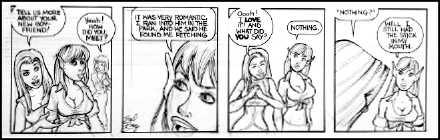
Selling original art is an integral part of the business model of an independent cartoonist who works with traditional media (pencils, inks, etc.). But if you use digital lettering, that final art might not feel so final to a prospective art collector. What should you do?
The content you are trying to access is only available to members.
What happens to your audience when the platform hosting your comic disappears? Brad and Dave discuss the news of Tapas shutting down and why owning your website, building a mailing list, and connecting readers through RSS remain essential tools for an independent comics career.
Then, Brad shares ways to breathe new life into a digital product whose sales have stalled. Finally, a listener asks about revising previously posted cartoons before submitting them to publications — sparking a discussion about first-publication rights, letting time be your editor, and applying yesterday’s lessons to tomorrow’s comics.
On this week’s show:
Pen names, professional identities, and some spectacularly silly alternatives.
The risks of building your audience entirely on someone else’s platform.
Mobile-friendly websites, newsletters, and RSS.
Reviving digital products through bundles, bonus content, new formats, sales, and membership gifts.
Revising published cartoons versus creating new work.
Building a buffer so you can edit with fresh eyes.
Being kinder to the younger cartoonist who helped you get here.
Publication update: Tapas has confirmed its service will end March 31, 2027. Tapas
An ISBN is a 10- or 13-digit number used to identify a book from a specific publisher. Once your book is in print, you can register the title and link it to the ISBN here.
The content you are trying to access is only available to members.
A Hugo Award nomination brought cartoonist Dave Kellett new readers, book sales, and Patreon supporters. Five days behind a WorldCon booth brought something else entirely: A serious crisis of confidence.
This week, Dave shares his WorldCon experience, from wonderful conversations with Drive readers to a painfully quiet dealers’ room. Brad and Dave discuss the emotional cost of a poorly performing convention — and why even an established cartoonist can mistake a bad show for a verdict on their career.
Along the way, they share John Picacio’s terrific metaphor for designing book covers, explore a storytelling approach that falls between planning everything and improvising everything, and discuss why an award nomination can deliver real business benefits without a win.
On this week’s show:
WorldCon’s strengths and challenges. How a convention built around fan participation, volunteer organizers, and panels differs from the comics shows Brad and Dave usually attend.
A better way to think about book covers. John Picacio’s approach: introduce your book as you would introduce an interesting friend at a party.
Connecting with your most dedicated readers. Why a small coffee gathering became one of Dave’s favorite experiences as an author.
Architect, gardener… or road tripper? Knowing your story’s major destinations while leaving room to discover what happens along the way.
The emotional cost of a bad convention. Five days, approximately $2,000 in gross sales, and one day without a single sale — compared with Dave’s $19,000 San Diego Comic-Con.
Award recognition and independent publishing. Why audience size matters in voting, and why a smaller readership can still support a strong business.
Making the most of a nomination. How Hugo recognition and a Bluesky starter pack helped bring new readers to Drive.
What’s next? Questions about webcomic eligibility, the possibility of a ComicLab nomination, and forthcoming Tales of the Drive stories from K. B. Spangler and Ursula Vernon.
The Butso Method will change the way you think about writing.
It’s very easy to get hopelessly lost during the writing process. We often have vague ideas of the general direction in which we want the overall story to go but no idea how to make that happen. It’s also easy to lose focus due to the vast possibilities we face. After all, we’re creating this story from literal nothingness, meaning anything can happen. But out of an infinite number of “anything,” which is right?!
When that happens, I find it helpful to focus on the basics, and that’s where the Butso Method comes in.
The content you are trying to access is only available to members.
Let’s face it. One of the biggest hurdles in growing a webcomic is reader retention. That’s why I encourage you to set aside time this month to develop (or improve) three ways to introduce your comic to a newcomer. Here are some ideas:
The content you are trying to access is only available to members.
There seems to be some misinformation about whether it’s legal to ship comics using the Media Mail service of the U.S. Postal Service. Since this misunderstanding could cost you hundreds of dollars, let’s get it straightened out now.
The content you are trying to access is only available to members.
Q. Could be a glitch but I just saw on my two websites that apparently the Patreon plugin has been removed from WordPress.org? Have you heard anything about this? This was reported on both my sites by Wordfence and I can’t seem to find their plugin via search anymore.
— from Bluesky follower
Editor’s Note: This story has been updated.
A. I checked into this, and you’re right! The official Patreon WordPress plugin was temporarily removed from the WordPress.org directory on October 6, pending review. There’s no official explanation yet, so we don’t know whether it’s a security issue or something else.
Interestingly, Patreon retired its legacy API v1 the following day, October 7. The timing is suspicious, but there’s no confirmation that the two events are connected.
This leaves folks in a bit of a pickle. Here’s my advice for moving forward…
The content you are trying to access is only available to members.
Should you launch a comic studio — or are you really talking about a comics collective, a shared workspace, or simply collaborating on a project? This week, Brad and Dave unpack what the word “studio” actually means and why adding another layer of branding might make your project harder, rather than easier, to promote. They discuss shared creative spaces, financial partnerships, anthology projects, comics collectives, and why most collaborations work better when everybody knows exactly what they’re signing up for.
They also argue that an anthology generally doesn’t need an umbrella “studio” brand at all. Keep the marketing focused on the book, make the financial responsibilities clear, and be wary of creating an organization that one hardworking person winds up carrying by themselves.
Also in this episode:
Kickstarter late pledges really work. Dave reports continued pledges long after his campaign ended — but Brad and Dave agree emphatically that you should never advertise late pledges while the campaign is still running. Kickstarter depends heavily on urgency and FOMO.
Why having more free time can make you less productive. Both Brad and Dave have experienced the strange phenomenon of getting less done when their schedules suddenly open up. They discuss rest, motivation, structure, and learning to shift to other useful tasks when the creative work isn’t happening.
Dave introduces his “Three Sisters” approach to productivity: when one part of your comics career isn’t moving, switch to another complementary task — bookkeeping, website improvements, promotion, admin work, or another creative project — so the overall career keeps moving forward.
Susan McTaggart returns! ComicLab’s internationally unverified motivational speaker offers another soul-fortifying affirmation.
And Dr. Reginald Wigglesby explores Lionel Feininger’s 1906 comic strip Wee Willie Winkie — with exactly the level of scholarly rigor longtime listeners have come to expect.